Friday, January 11, 2013

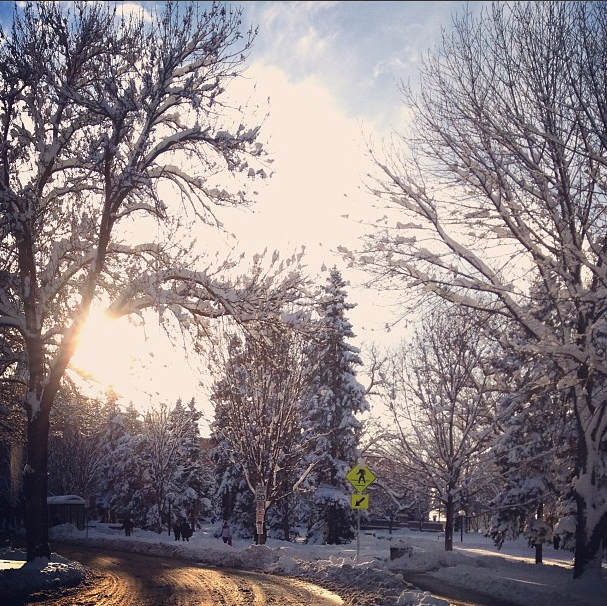
Winter Break in Michigan

Now that I'm a little more than halfway through winter break, I've finally made it home to Michigan for the first time since August. The band trip to Houston kept me away until after New Years, and fall semester kept me so busy that I couldn't even spend a weekend at home. So it's certainly nice to be back for a two week break from campus and the Twin Cities.

Here's my band on the field in Houston before the bowl game! 
I'm one of the little gold dots in the "8"!

The best part about coming home is seeing all the plants my parents have. Almost every room in the house that gets some sort of light has greenery tucked in the corners. The front window that gets lots of southern sun in the winter has our largest tropical plant, gorgeous flowering African violets and a Christmas cactus just finishing up a cycle of blooms.


The kitchen is also full of mason jars full of cuttings of the coleus with lovely root systems starting. Some of these are the coleus plants I started in my plant propagation class last year that we had outside our house this summer. These cuttings will be able to go back out in the spring for another year of potted summer greenery.


Once I got back, I booked it (pun intended) straight to the library and checked out a big stack of horticulture and gardening books. A lot of my free time has since been spent reading and taking notes in the garden journal I've fashioned out of a barely used sketchbook. To keep this post from running too long, I'll have another post about making a garden journal later this week.


A few snippets and ideas I've found:
1. Freeze smaller, edible flowers or their petals in ice cubes to make a pretty, decorative addition to your summery drinks.
2. Use plastic take out containers to start seedlings in early spring. Since they already have a clear cover, you won't have to put a plastic bag over them. Be careful of plastics, however, and stay away from plastics 3, 6 and 7. You can find this number on the bottom of the container.
3. You can actually eat daylily buds before the flowers bloom. One book recommended sauteing them like peas!
4. Pinks can actually be infused in wine or vodka and some begonia petals can be eaten but are sour like lemons.

Some of my time has also been spent reading the book my younger sister got me for Christmas, "A Victorian Flower Dictionary" by Mandy Kirkby. It's a fascinating little book with pages of flowers and their meanings, often accompanied by little snippets of literature or poetry.


My discovery of the week, however, has been a really fun gardening program you can watch for free on Hulu.com. It's simply called "Organic Gardening" and it's a gardening and horticulture program out of Australia. Since it's such a different climate than the one many of us are living in up in the Northern Hemisphere, some of the things in the gardens down there might not work in our gardens and their seasons certainly are different than many of ours. But it's still very interesting from a horticultural perspective in learning about how gardening works in a different part of the world. And, of course, some of the gardening advice, such as how to prune apple trees and ways to fix common garden problems, are the same as anywhere else. You can find the program here if you'd like to check it out. Ever the multi-tasker, I've enjoyed watching it while writing in my garden journal and finding magazine cuttings to decorate it.

In my next post, I'll be talking more about the making of my garden journal (along with some rather fuzzy photos of the journal taken with my phone camera) and some ideas for getting your own started, if you don't have one already. 

Sunday, December 23, 2012

Happy Holidays!


I survived finals! I'm so thankful to have a whole month of winter break ahead of me. A small amount of it will be spent in Houston, Texas because my college football team is playing in a bowl game there on the 28th and the band is going too! Then it'll be home or a little more than a week in January and the rest of the time will be spent relaxing in Minnesota.

In honor of the holidays, I did a little research on the lovely poinsettias that grace all the holiday displays every year.

1. Poinsettias are native to Mexico and the ancient Aztecs, who called the plant "Cuetlaxochitl", used their colorful bracts (the red part) to make dyes and the sap was used as a fever medication.

2. Poinsettias were first only known by the Latin name Euphorbia pulcherrima, meaning "very beautiful".

3. The plant got it's current common name from Joel Roberts Poinsett, the first US ambassador assigned to Mexico by John Quincy Adams. While in Mexico for his work as an ambassador, Poinsett, who was also an avid botanist, collected plants to bring back to his home in South Carolina and is known for officially introducing the poinsettia to the United States. A man named William Prescott, who was given the task of giving Euphorbia pulcherrima a new name had been working on a history of Poinsett and assigned the plant the new name of "Poinsettia".


4. This plant is very popular around Christmas as the flowers are said to represent the star that guided the wise men to the baby Jesus. The color red also symbolizes the blood sacrifice of the crucifixion of Jesus. Today, the flower is known in Mexico and Guatemala as "La Flor de la Nochebuena" (or "The Flower of Christmas Eve").

5. In Spain, poinsettias are used as an Easter flower as opposed to the popular use as a Christmas flower elsewhere.

6. Contrary to popular belief, poinsettias are only mildly toxic, meaning children and pets would have to eat a lot of poinsettias before dying. A study at Ohio State University shows that you'd have to eat 500-600 leaves before the side effect would be death. That being said, eating them would still cause an upset stomach an vomiting and apparently they don't taste very good anyway, so why you'd want to even try them is beyond me.

(I find this picture hilarious. He's so grumpy!)

7. Poinsettias are mostly grown in California and their sale contributes more than $250 million to the US economy at the retail level.


(Source)

So now that you all have a few interesting facts to impress your family and friends this season, I'll be signing off for a while to enjoy Christmas with my family here in Minneapolis. My family surprised me by coming down from Michigan a day early and we got to my grandmas to find all the decorations up (as you can see below). So I wish you all a very Happy Holidays, Merry Christmas and a very festive New Year. :)

Wednesday, December 12, 2012

Accepted!

"Congratulations! You have been admitted to the College of Food, Agricultural and Natural Resource Sciences (CFANS) for Spring Semester 2013. Welcome to CFANS!"

Yesterday morning I woke up to this lovely sentence starting the first email in my inbox. I'm officially a Horticulture major! No more, "potential" about any of it. As an added bonus, one of my really good friends got the same email as well. So we're finally, officially in the track to getting our Bachelor of Science in Horticulture.

Also, IT FINALLY SNOWED!


And with that update, back to finals week studying! Happy Wednesday everyone!

Sunday, December 2, 2012

Finals

This will be a rather short post, but just as a heads up, I will be disappearing into the depths of finals week (or should I say finals month!) starting tomorrow so I won't be posting very much.
On a happier note, once school is out for break I'll have a month off to post a good amount. I'm also going to be traveling to Houston, Texas right after Christmas as my band is attending a bowl game that my University's football team is playing in. I'll try to post some pictures of any plant related things I see down there. :)
Until then, I might post once, but I'll be studying as much as possible in the coming weeks.
See you all around the holidays!

Monday, November 26, 2012

Find of the Day

While surfing the internet today I found a really awesome product that ties in with the aquaponics post I put up yesterday. It's quite similar to the large beds of vegetables fed by water from fish tanks, only in miniature (and much more compact and stylish!).
The page is titled "One Pot, Two Lives" (click the title for the link) and is a fish tank and flower pot all in one. The fishy's waste feeds the plant while the plant filters the fish's water. You still have to feed the fish, but there doesn't look to be a whole lot of nasty fish tank cleaning involved.


It also does look like it needs to be plugged in, probably for a bubbler to keep the fish water moving.  Hopefully it would be a simple fix if it broke and wouldn't need to be thrown away if only part of it broke. 


It's not specific as to if certain kinds of plants are preferred over others. It would certainly be an awesome thing to have in a small apartment like the one I live in. Surfing through the comments, it seems that the only fish that would work in a small environment like this would be a beta fish or a goldfish. No one knew if there was a heater in this product, but both of those fish don't need one because they're okay with colder water temperatures. Of course, most of the debate centered around if it was "cruel" or not to keep a fish in such a small container. But I say that's up to the individual to decide. The concept is, however, a really cool one. It would be neat to see if this could be made into something a bit larger, possibly on the size of a regular fish tank with multiple fish and plants.


Sunday, November 25, 2012

Lots of Plants, Small Spaces

Today, being the last day of our long Thanksgiving weekend, I decided to spend the day browsing gardening blogs, pinning great garden projects to Pinterest and getting sucked into some great videos about urban farming and hydroponics on Youtube. I found these through one video I saw while browsing the blog The Blogging Nurseryman by Trey Pitsenberger.
I thought I'd share a few.

1. Internet of Food: Ardunio-based, Urban Aquaponics in Oakland
This video was the one I found on Trey Pitsenberger's blog and led me to the others. The concept of aquaponics with a garden fed by water from a fish tank was new to me and the video was really informative. I also loved the technology element, one in which the gardener can interact with their garden through the internet. Figuring this technology out now in order to pass it on to younger gardeners, ones who will be inheriting a world where there's a need for smaller gardening spaces and new ways to grow what we need.


2. Biointensive Mini-Farming: Grow More Food in Less Space
This video was a neat look into how one person can grow all the food (if you're a vegetarian that is) they could need in a small space. One of the most interesting things to me was the grains being raised and how many of them were alternative grains to regular wheat.


3. Urban Forest Erupts in San Fransisco's Edgy Tenderloin
I loved this video. This is about a garden springing up in an alleyway between apartment buildings in the middle of a densely populated area of San Fransisco. The greenery just seemed that much, well, greener surrounded by all that concrete. The local art decorating the buildings and the clay oven they actually cook were really cool touches. My favorite part was the the words "Our Lady of the Alley" painted around the oldest resident's kitchen window that looked out upon a cherry tree they planted just for her.


4. Soil-less Sky Farming: Rooftop Hydroponics on NYC Resteraunt
The last video was about a resteraunt in New York City that grows it's fresh produce on the roof of it's building. Climbing up six stories, you'll find the roof covered in tall, very thick PVC-looking pipes that have notches cut into the sides where the produce grows, fed by water that is mixed with fertilizer and pumped through the top of the pipe to rain down the sides and water the plants. It was another really good look at a method of hydroponics I'd never seen and was interesting to see how much faster the plants grew in this way and how high a yield the restaurant gained from it.


 All of these videos certainly inspired me because at this point I'm starting to look at focusing my major towards things like urban farming and other sustainable methods of growing food in the spaces left to us, ones that just keep getting smaller and smaller. I find it fascinating how resourceful we can be when it comes to feeding ourselves and the new ways we find to go about doing so.
The videos were found on the channel of the co-founder of *faircompanies where all of these videos and a lot more can be found. The channel has a lot of videos on individuals, small companies and businesses who are doing projects in a much more different and sustainable way. I certainly enjoyed the one about the couple who build hobbit holes as playhouses, chicken coops and even tiny cottages. I'd definitely check some more of them out because there will probably be quite a few more of interest to you.

Wednesday, November 14, 2012

And I'm Back!

Hello all!
I'm sorry for not posting for about 2 months. I can't believe it's been that long. It's felt like only a few weeks!
Like I said in my last post, this semester's been pretty crazy. My classes have been going okay. I'm just barely making it through my algebra course (I'm terrible at math) and struggling to pass my online chemistry course. I'm just hoping it all turns out okay in the end.
As far as updates on the horticulture major, I'm talking to the department adviser tomorrow to get details about switching into the college I need to declare the major and what courses I should take next semester. At this point I'm looking at Intro to Microeconomics, Intro to Soil Science and a basic Biology course. I'd only be taking three courses, plus a campus band and pep band so hopefully I would have time to look for a job/work once I find a job. Because I'm a poor college student and really just need to work. :P

As far as personal updates go, one big reason I didn't post at all last month was because on the 14th I was in a car/pedestrian accident where my boyfriend, his dad and I (and three other people I didn't know) were struck by a drunk driver as they made a left turn (not yielding to the bunch of people crossing the street with the right of way). Everyone that was involved was okay, my boyfriends dad with the worst injuries of a broken leg and slightly fractured shoulder. I had a lot of bruises to my knees because that was where I was struck and some bumps and bruises from being thrown, but an MRI and multiple doctors visits confirm that I don't have anything more serious than some deep bruising in my legs. At this point, I'm almost healed up, but it'll probably be another two weeks before the majority of the bruises are totally gone. We were really lucky though, so I'm super super thankful for that.

Needless to say, all that craziness really threw my academics off. So I probably won't be getting the best grades this semester, but hopefully I can pull a pass in everything.
My horticulture class is going pretty well. Memorizing Latin names is certainly a challenge, but I tend to do a lot better than I assume I will, so it's pleasantly surprising to get good grades back. For our last midterm we were required to learn the common and Latin names of 70 deciduous trees... Somehow it managed to be my best test score yet in that class. Our next midterm that's coming up next week is on the conifers and thankfully there's not as many trees to memorize this time. :)
That's about all the updates I have for you guys. I hope you're still reading! I'll leave you with some pictures I've taken during our class walks around campus. :)
-Abby